Sambar & Sides
Rasam Recipe: Why You Must Never Boil It Hard
Rasam is thin, sour and peppery, and it is ruined by the thing most cooks do to it: boiling. Here is the froth rule and the versions worth knowing.

Which dal, how much tamarind, whether to roast your own powder, and the order vegetables go into the pot so nothing turns to mush.
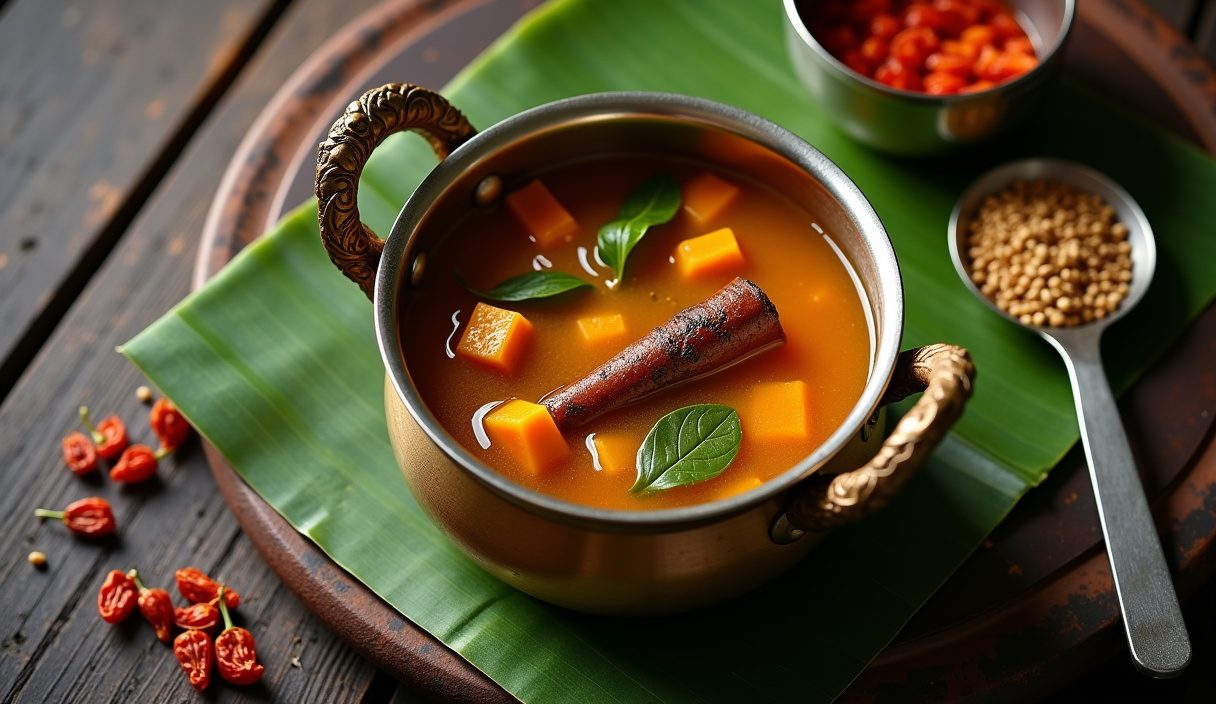
Sambar is the dish that makes a South Indian meal a meal. It is a tamarind-soured lentil stew, thick with vegetables, and it appears at breakfast beside idli, at lunch over rice, and at dinner with dosa. There is no single correct version. What follows is the Tamil-style sambar I grew up with in Madurai, with notes on where the Udupi and Kerala versions diverge.
The three decisions that actually change the result are the dal, the tamarind, and whether you roast your own spice blend. Everything else is detail.
Use toor dal (arhar, pigeon pea). It cooks to a soft, creamy purée that gives sambar its body. Masoor dal cooks faster but falls apart into something thinner and sweeter. Moong dal makes a lighter stew that is pleasant but is not sambar.
For four to six people, 3/4 cup of toor dal is right. Rinse it until the water runs mostly clear, then pressure-cook with 2 to 2.5 cups water, a pinch of turmeric and a few drops of oil (the oil stops it foaming over) for four to five whistles, or twenty minutes in a pot. It should be completely soft — mash it with the back of a ladle and it should give way without resistance. Undercooked dal is the most common reason a sambar tastes thin.
Tamarind is what makes sambar sambar rather than dal. Use a lime-sized ball of wet tamarind soaked in a cup of hot water for fifteen minutes, then squeezed and strained. If you use concentrate, start with a heaped teaspoon and taste, because concentrates vary enormously in strength.
Get the quantity wrong in either direction and the dish fails in a recognisable way. Too little and it tastes flat and faintly sweet. Too much and it is puckering and metallic, and no amount of jaggery will fully rescue it. Add tamarind water in two stages, tasting after the first, and you will not overshoot.
Good shop-bought sambar powder makes a perfectly respectable sambar, and on a weeknight that is what most households use. Roasting your own is noticeably better and takes fifteen minutes. If you cook sambar more than occasionally, make a batch every couple of months.
For a small jar, dry-roast separately, each until fragrant and a shade darker: 1/4 cup coriander seeds, 2 tablespoons chana dal, 1 tablespoon toor dal, 1 teaspoon cumin, 1 teaspoon black peppercorns, 1/2 teaspoon fenugreek seeds, 10 to 12 dried red chillies, and a sprig of curry leaves. Cool completely, then grind fine with 1 teaspoon turmeric. Roasting each item separately matters because they brown at different rates; fenugreek in particular turns bitter fast.
Classic choices are drumstick, pumpkin, brinjal, okra, carrot, radish and small shallots. Shallots (sambar onions) are the one I would not skip; they turn sweet and hold their shape.
The order matters because the vegetables cook at different speeds, and a sambar where everything went in together is a sambar where the okra has dissolved and the drumstick is still woody. Working from a pot of simmering tamarind water:
The tempering (tadka) goes in at the very end and it is not a garnish — it is a third of the flavour. Heat 2 tablespoons of sesame oil or ghee until shimmering. Add 1 teaspoon mustard seeds and wait for them to pop properly. Then a pinch of fenugreek seeds, 2 dried red chillies broken in half, a generous sprig of curry leaves, and a pinch of asafoetida. The curry leaves should crackle for two or three seconds only. Pour the whole thing over the sambar and cover the pot for a minute to trap the aroma.
Udupi sambar is sweeter and milder, and the spice blend is ground with fresh coconut, which makes it thicker and rounder. Kerala varutharacha sambar takes this further: the coconut is roasted until genuinely dark brown before grinding, giving a deep, almost nutty stew. Arachuvitta sambar, the Tamil festival version, grinds the spices fresh for that single pot rather than using stored powder, and it is worth doing once to taste the difference.
Add a little more cooked dal and water to dilute, plus a teaspoon of jaggery. Jaggery alone will not fix a badly over-soured pot; you need to dilute as well.
Either not enough dal or the dal was undercooked. Mash some of the cooked vegetables into the stew, or simmer uncovered to reduce. A tablespoon of rice flour slaked in water works in an emergency but changes the texture.
Usually the powder went in at the end and never cooked. Simmer it in the tamarind base for five minutes before anything else goes in. Also check your salt and make sure the tempering used asafoetida, which carries a lot of the savoury depth.
Yes, and it is better on the second day. Make it without the fragile vegetables, refrigerate, then reheat with a fresh tempering. It keeps three days refrigerated. It thickens as it sits, so loosen with hot water when reheating.
Over hot rice with a spoonful of ghee, it is lunch. Beside idli or dosa, it is breakfast. With medu vada dropped straight into the bowl, it is sambar vada. Make a coconut chutney alongside and you have the standard tiffin plate, and for the lighter counterpart at the end of a rice meal, see our rasam guide.
Rasam is thin, sour and peppery, and it is ruined by the thing most cooks do to it: boiling. Here is the froth rule and the versions worth knowing.
The white coconut chutney most people mean by the word, plus tomato, coriander, peanut and onion versions, and the tempering that finishes all of them.
The rice to dal ratio, why fenugreek belongs in the soak, how long to ferment at your room temperature, and what to do when the batter refuses to rise.